The gap where inbound revenue disappears
For a growing B2B business, inquiries arrive from everywhere at once — the website contact form, WhatsApp, a phone call, an email, a referral from an existing customer. The problem is rarely a shortage of interest. It is that no single system owns what happens next. An inquiry lands in one person’s inbox, waits, and by the time anyone follows up the customer has already spoken to a competitor who replied first.
This is the most expensive kind of loss because it is invisible. Nothing shows up as a rejected quote or a lost tender. The opportunity simply never becomes a conversation, and the month closes a little short with no obvious reason why. When you cannot see a loss, you cannot fix it — and unmanaged inbound is a slow, permanent leak.
The businesses that win inbound are not the ones with the flashiest website. They are the ones where every inquiry, from every channel, enters one accountable process the moment it arrives.
Capture every inquiry, automatically
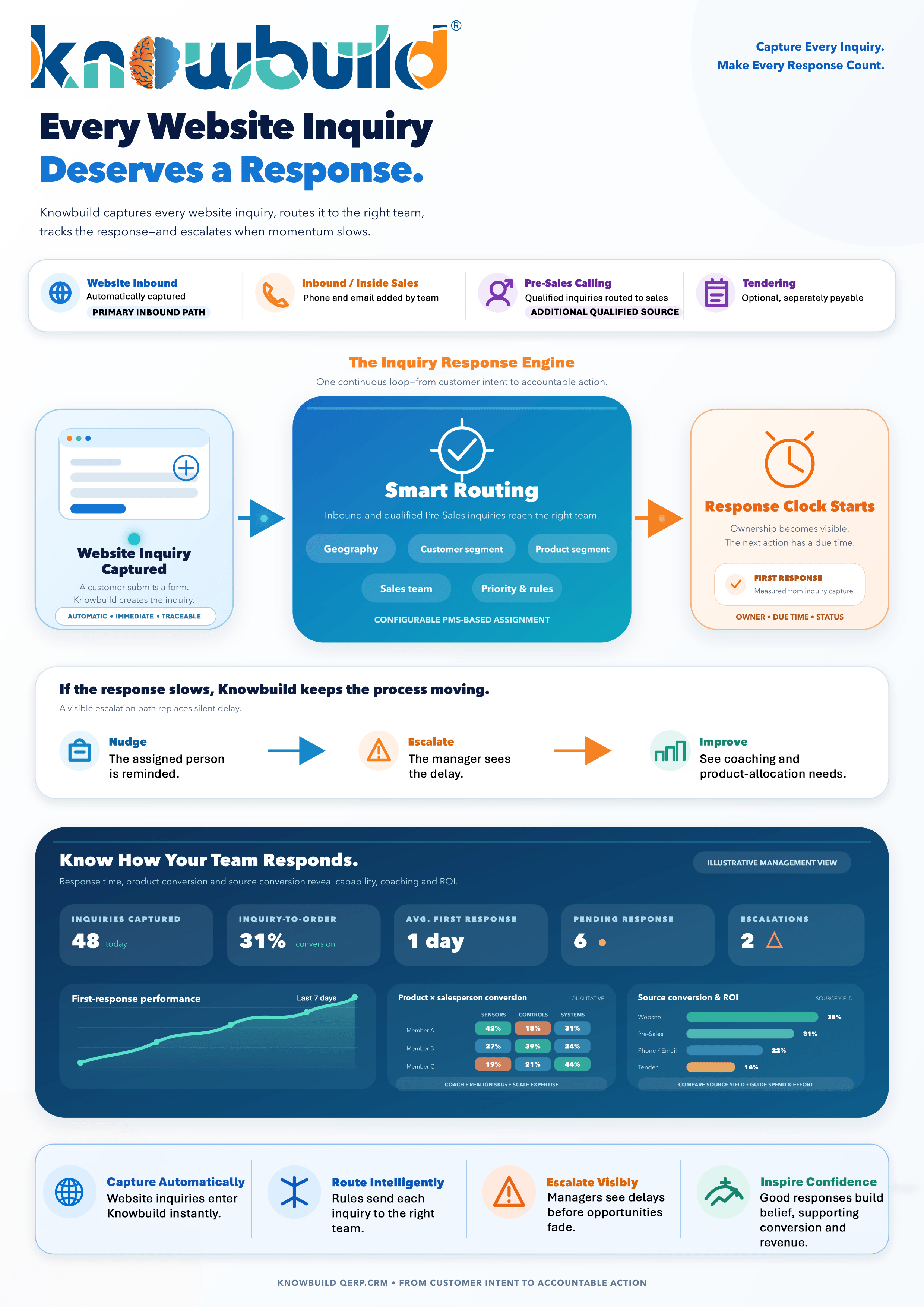
The first discipline is capture. Every website inquiry should enter your system the instant a customer submits a form — automatically, immediately, and traceably — rather than sitting in a shared mailbox that three people half-watch. Phone and email inquiries added by the inside-sales team, and qualified pre-sales inquiries, all land in the same place, so there is one record of demand instead of five disconnected ones.
When capture is automatic, two things become possible that spreadsheets and inboxes can never deliver. First, nothing depends on a person remembering to log an inquiry; the system does it. Second, every inquiry carries a timestamp from the exact moment it arrived, which is the foundation for measuring and improving response speed.
Automatic capture also removes the quiet politics of ownership. When leads live in one person’s inbox, they are effectively that person’s to win or lose. When they enter a shared system, they belong to the business, and the business can make sure each one is worked.
Route it to the right person, then start the clock
Capture is only half the job. An inquiry captured but sent to the wrong person, or to a general queue no one owns, is barely better than one lost in an inbox. Smart routing sends each inquiry to the right salesperson based on rules you define — geography, customer segment, product segment, priority — so leads reach the person best placed to win them instead of the person who happens to see them first.
The moment an inquiry is assigned, a response clock starts. Ownership becomes visible, the next action has a due time, and first-response time is measured from the point of capture. That single number — how long a customer waits for a first response — is one of the most reliable predictors of whether an inquiry converts, and it is impossible to manage if you never record when the inquiry actually arrived.
Good routing also respects how a real sales team works. A senior salesperson handles key accounts; a regional rep handles their territory; complex product questions go to someone who knows that line. Encoding those rules once means every future inquiry is routed correctly without a manager triaging the queue by hand.
Escalate before momentum fades
Even a disciplined team gets busy. Someone is travelling, someone is closing a big order, and a handful of inquiries slip. In an informal setup, that slip is silent — the lead simply ages until it is cold. A standardized process replaces silent delay with a visible escalation path.
First, the assigned person is nudged that a response is due. If the inquiry still sits, the manager sees the delay while there is still time to act. Over weeks, the pattern of where responses slow down becomes data: which salespeople are overloaded, which product lines generate questions no one can answer quickly, where coaching or reallocation would help. Escalation stops being a reprimand and becomes a management signal.
The result is a team that responds faster because the system, not memory, keeps every inquiry moving — and customers who feel attended to, which is exactly where trust and conversion begin.
What the numbers reveal about capability
Once inbound runs through one system, a management view emerges that most SMEs never had: how many inquiries were captured today, the inquiry-to-order conversion rate, average first-response time, how many responses are pending, and how many have escalated. These are not vanity metrics; they are a live read on the health of the top of your funnel.
The same data reveals capability at the level of people and products. Response time, product conversion, and source conversion together show where a salesperson excels, where coaching would pay off, and which lead sources actually produce orders versus noise. You can see that website inquiries convert at one rate and referrals at another, and spend your effort accordingly.
This is how inbound stops being a matter of faith and becomes a managed asset. You know what is coming in, how fast you respond, what converts, and where to improve — and you can prove the return on the marketing that generates the inquiries in the first place.
Turning first responses into customer confidence
There is a human dimension underneath all of this. A prospect who submits an inquiry is, in that moment, uncertain — about your product, your reliability, whether you will even reply. A fast, relevant first response is the first evidence they get that you are a business worth trusting. A slow one, or none, is evidence of the opposite.
Every good response compounds. It builds the belief that supports the eventual order, and it sets the tone for a relationship that, handled well, becomes repeat business. This is why capturing and routing inbound is not merely an operational tidy-up; it is the front door of your brand experience.
For a growing Indian B2B SME competing against larger and better-resourced rivals, responsiveness is one of the few advantages you fully control. You may not outspend a competitor, but you can out-respond them — and a system that captures, routes, and escalates every inquiry is what makes that advantage repeatable.
One process for every channel
A practical challenge for Indian B2B SMEs is that inquiries do not arrive through one tidy front door. A customer might fill in a website form, another sends a WhatsApp message, a third calls the office, a fourth emails a purchase manager directly, and a fifth comes as a referral mentioned in passing. Each channel has its own habits and its own risk of being handled informally and then forgotten.
The discipline that makes inbound work is convergence: every channel, however the inquiry arrives, feeds into the same process with the same capture, the same routing, and the same response clock. A WhatsApp inquiry logged into the system is treated with exactly the same rigour as a website lead, rather than living and dying in one salesperson’s personal chat. The channel is just the doorway; once inside, every inquiry is equal.
This convergence also makes measurement honest. When every channel runs through one process, you can finally compare them fairly — which sources produce inquiries that convert, which produce volume but little value, and which are quietly neglected because they land in a place no one systematically checks. Without one process, channel performance is guesswork; with it, you can invest in what works and fix what does not.
Where to start
If you do one thing, make capture universal: ensure every inquiry from every channel — website, WhatsApp, phone, email, referral — lands in one system with an owner and a timestamp. That alone stops the largest source of silent loss.
Next, encode your routing rules so inquiries reach the right person automatically, and switch on a response clock so ownership and speed are visible. Finally, add the escalation path so no lead ages in silence. Each step is small; together they change how much of your existing demand you actually convert.
None of these steps requires a large team or a long project. They require a decision that inbound will be run as a process rather than left to chance, and a system that enforces that decision consistently once it is made. The businesses that treat inbound this way do not necessarily generate more inquiries than their competitors; they simply lose far fewer of the ones they already have, which is usually the faster and cheaper path to growth.
The promise is straightforward: no inquiry slips through the cracks, every customer gets a timely first response, and your team’s effort goes to the opportunities most likely to become orders.
Key takeaways
- Most inbound revenue is lost in the delay between inquiry and first response, not on price.
- Automatic capture puts every website, WhatsApp, and phone inquiry into one traceable record.
- Rule-based routing plus a response clock makes ownership and speed visible.
- A visible escalation path keeps leads moving before they go cold.
- Response data turns inbound from a matter of faith into a managed, measurable asset.
Put the insight into action
Build a business process your team can actually follow.
See how Knowbuild connects inquiries, follow-ups, quotations, orders, inventory, dispatch, finance, and execution in one Business Operating System.
Book a demo