Sanjay’s week, before and after QERP.CRM.
Follow one order through a growing distribution business, first the way most SMEs run today, then on QERP.CRM.
Sanjay owns the business, and he is still on WhatsApp. A customer says nobody replied to his inquiry from last Tuesday. The warehouse says the kit he promised is short of one part. Accounts can’t tell him who has paid. His salespeople will send their weekly reports on Saturday.
Every answer lives in someone’s head, so every question comes to him. The business can only grow as fast as Sanjay can answer his phone.
Every inquiry is caught, routed and timed
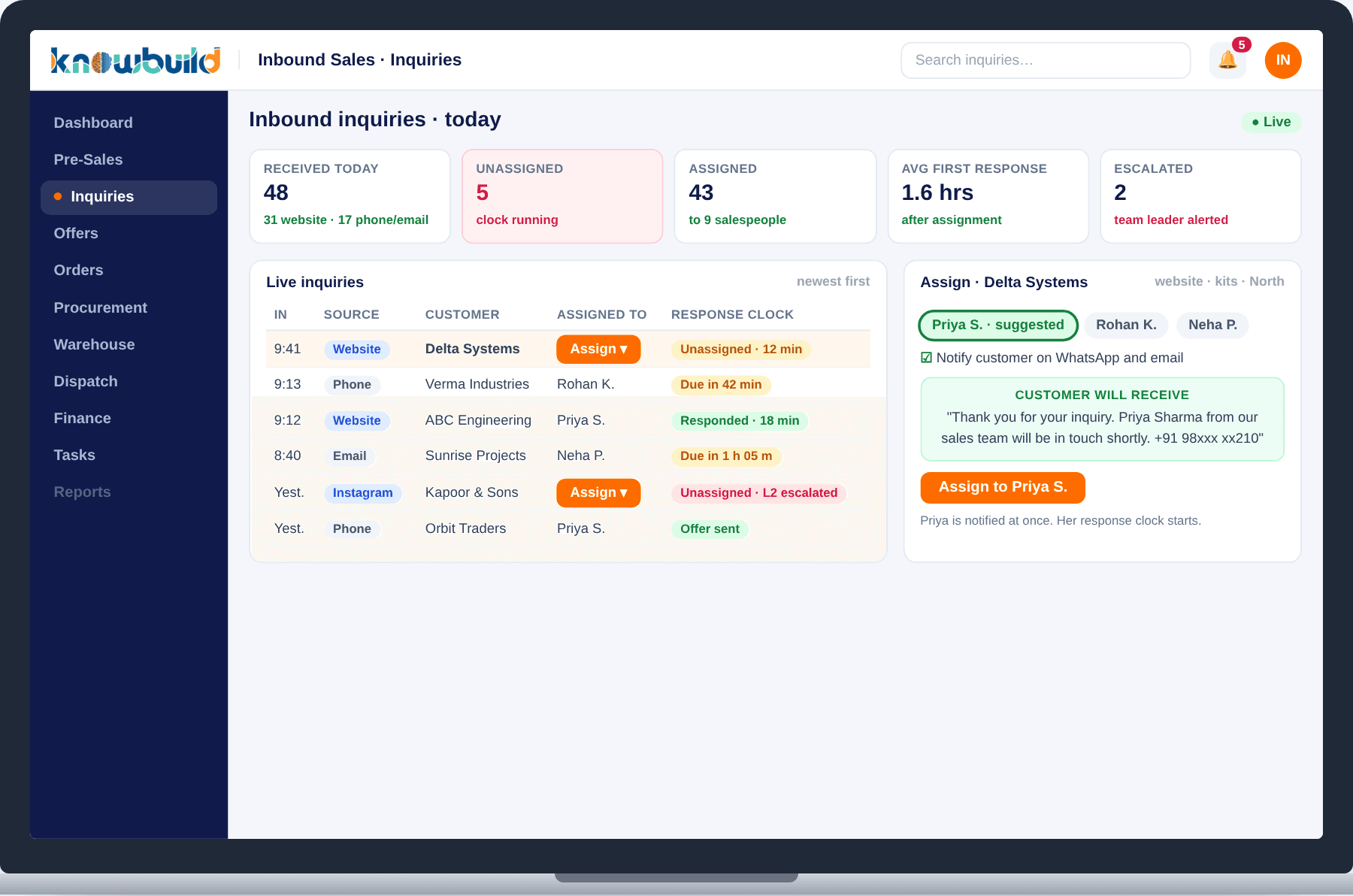
A buyer fills in the form on the website, and it lands in QERP.CRM on its own. Another calls, and the inbound team adds that inquiry too. The inbound screen shows 48 inquiries today, 5 not yet assigned. The team assigns each one to the right salesperson, and the customer is told automatically, on WhatsApp and email, who will be in touch. Priya’s response clock starts. If she is slow, she is reminded, then her manager sees the delay.
Priya sends an offer quote that can actually be delivered
While she builds the offer, she sees whether each line is a product, an accessory or a kit, and how much is in stock. Discount rules are already set, so margins stay protected through every revision, from V1 to V3. If the offer is large, the system notifies her team leader and product manager. She sets a follow-up date, and the system will not let it slip.
Priya uploads the order once, and every team works from it
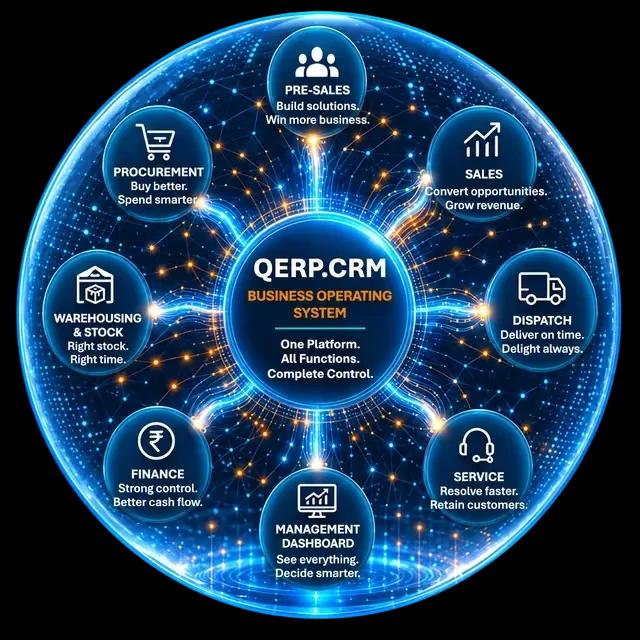
ABC Engineering sends its PO for 120 units and 20 kits. Priya uploads it once. Sales, purchase, warehouse, dispatch and finance all work from that one record. The customer’s credit limit and credit days are checked. The order needs more units than are in stock, so purchase sees a Purchase Alert before anyone has to ask.
Purchase buys the right quantity, at the right price
The system recommends how much to buy, and drafts the PO in one click. The buyer can see every past vendor for that item and the last price paid. The PO goes for approval. When the goods arrive, the warehouse records the receipt and the serial number of every unit, and the stock is live.
Kits are built, goods ship, the invoice makes itself
The 20 kits are put together from parts in stock, and each part leaves stock only when it ships. Half the order goes today, the rest on Friday. If the customer has crossed his credit limit, no e-invoice can be raised. Here he hasn’t, so the GST e-invoice, with IRN and QR code, and the e-way bill are made with the invoice.
The payment is chased without anyone chasing
The customer gets a polite WhatsApp reminder after 1, 7 and 15 days. Accounts note the date he promised to pay, and are reminded on that day. If the amount stays overdue, it moves from Priya to her team leader, then to the manager. When the money arrives, Priya is told and the customer’s PO is closed.
Sanjay sees his whole business on one screen
Sales against target, this month and this year. The opportunity pipeline. Orders in hand. What customers owe, and what is overdue. Cash position. Open purchase orders. There are no weekly reports to wait for: every salesperson’s plan before a meeting, and what happened after it, is already on the deal.
The bank asks. A customer calls about one unit.
Every document is still attached to its order: bills of entry, airway bills, vendor import invoices, outgoing invoices and payment references. Type in a serial number, and you see which invoice it went out on, and when.