The real question is not if, but what and when
When owners ask ‘are we big enough for a CRM?’ or ‘is it time for an ERP?’, they are usually asking the wrong question. The issue is almost never whether a business is large enough to deserve a system. It is which system fits the stage the business is at, and when to add the next layer of infrastructure underneath it.
Getting this right saves money in both directions. Adopt too much system too early and you pay for complexity you cannot use. Wait too long to put the right foundation in place and you pay in lost inquiries, botched handovers, and decisions made on numbers you cannot trust. The goal is to match the infrastructure to the stage — not to over-build, and not to keep running a growing business on memory and spreadsheets.
So let us answer both questions directly, with rough numbers, and then explain the reasoning — because the thresholds only make sense once you understand what each layer is actually for.
No company is too small to start a CRM
Start with the clear part: no company is too small — or too large — to start using a CRM. Even a business turning over Rs 25 lakh a year should be running one. At that size a CRM is not a luxury or a sign of corporate ambition; it is foundational infrastructure that makes future growth possible.
The reason is simple. A CRM’s core job is to make sure no inquiry is forgotten and every follow-up happens. A small business has fewer inquiries, but each one matters more, and losing a handful to missed follow-ups hurts proportionally more than it would for a large firm. The habit of capturing every lead and working it systematically is exactly the habit that lets a small business become a bigger one.
There is also a compounding benefit to starting early. A business that adopts a CRM at Rs 25 lakh builds its customer history, its follow-up discipline, and its sales data from the beginning. By the time it is several times larger, it has years of structured information and an ingrained way of working — rather than a scramble to impose order on a business that grew up without it. Starting small is not premature; it is the foundation.
Why even the smallest business benefits
It is worth being concrete about what a small business actually gains, because ‘you should have a CRM’ can sound like generic advice. First, nothing gets forgotten: every inquiry from every channel is captured, and every promised follow-up is scheduled and reminded. For a small team wearing many hats, that alone recovers real revenue.
Second, the business builds memory that does not depend on any one person. When customer history, past quotes, and conversations live in a system rather than in an owner’s head, the business becomes more resilient — it can bring on a second salesperson, survive someone taking leave, and keep serving customers consistently.
Third, even simple data starts to guide decisions: which inquiries convert, which products sell, where time goes. A small business that can see these patterns makes better choices about where to focus. None of this requires a large or expensive system — just the discipline of a CRM, adopted early, as the foundation everything else will be built on.
When to move to a business operating system
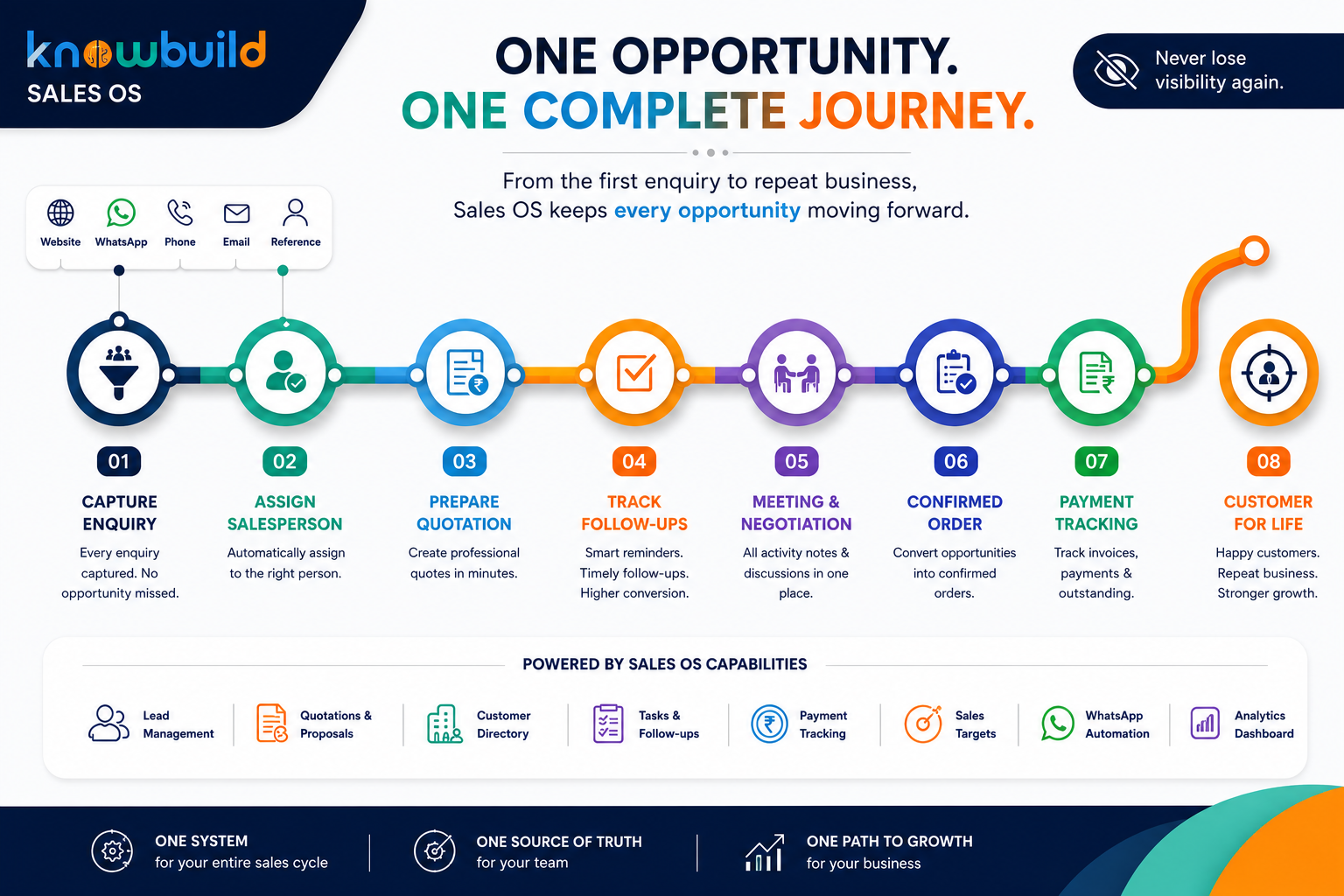
The second question — when to graduate from a standalone CRM to a full business operating system that combines CRM and ERP — has a more specific answer. As a rough guide, a business is ready for a QERP business operating system when it is at around Rs 5 crore in turnover and growing, and has reached roughly 15 people or more.
Those two thresholds — revenue and headcount — matter together, not separately. Rs 5 crore and growing signals enough transaction volume and complexity that disconnected tools start to cost more than they save. Fifteen-plus people signals that the business has crossed the point where everyone can hold the whole operation in their heads; there are now enough hands that coordination itself becomes the constraint.
Below these thresholds, a good CRM plus simple accounting often suffices, and a full operating system may be more than the business can use. At and above them, in a business that is still growing, the disconnected setup begins to actively hold the company back — and that is the moment to put the fuller infrastructure in place.
Why size and headcount are the threshold
The thresholds are not arbitrary; they mark the point where the nature of the problem changes. Under about Rs 5 crore and 15 people, the main risk is forgetting things — a lost inquiry, a missed follow-up — which a CRM solves. Above that, the main risk shifts to coordination: handovers between sales, stock, dispatch, and finance start to break, and no single person can see the whole business anymore.
That is precisely the problem a business operating system is built for. It carries one record from inquiry to cash so that every team — sales, procurement, warehouse, dispatch, finance — works from the same truth, without re-keying or reconciliation. Below the threshold this connectivity is nice to have; above it, in a growing firm, it becomes the thing standing between controlled scale and daily chaos.
Growth is the key word in the threshold. A stable Rs 5 crore business that is not trying to expand may be perfectly well served by simpler tools. It is the combination — Rs 5 crore or more, 15-plus people, and still growing — that signals a business about to strain its informal systems, and therefore ready for real operating infrastructure before the strain does damage.
From a few decision-makers to teams that must stay aligned
There is a human version of this threshold that owners feel before they can name it. When a business is small, one or a few people decide almost everything — the same person, or a tight group, handles procurement, sales, dispatch, and finance, often in the same afternoon. Alignment is effortless because it all happens in a few heads that talk to each other constantly. Nothing needs to be written down or connected, because the whole business already lives in the room.
As the business grows larger, that stops being possible, and it stops being desirable. To handle more volume you have to delegate — to give each function real autonomy under its own team lead: a procurement lead, a sales lead, a dispatch lead, a finance lead. This is healthy and necessary; it is how a business scales beyond the founder’s personal bandwidth. But it introduces a new risk that did not exist before: each team, optimising its own corner, can quietly drift out of step with the others. Procurement buys without seeing real sales demand, sales promises what dispatch cannot deliver, finance is surprised by both.
The only way autonomous teams stay coordinated at scale is if every function lead is working from the same data — one shared, current picture of the business rather than each team’s private spreadsheet. That is precisely what a business operating system provides: one connected record so that each team can move fast and make its own data-based decisions independently, while staying on the same page as everyone else. It is what allows the same-sized team to handle a much larger volume of business, because coordination is carried by the shared system instead of by constant meetings and manual reconciliation.
This is the quiet transition every scaling SME has to make: from a business that runs on a few people knowing everything, to a business that runs on many people trusting the same source of truth. The operating system is the infrastructure that makes the second model possible — and attempting to grow large without it is what forces owners back into the bottleneck of deciding everything themselves.
It is infrastructure, not just software
Here is the shift in thinking that makes the timing clear. A business operating system like Knowbuild is not just an ERP you buy when you get big. It is infrastructure you put in place to grow — in the same category as electricity or an internet connection. You do not wait until a business is huge to give it power and connectivity; you install them because they are what make everything else possible.
Framed this way, the question stops being ‘can we justify the expense?’ and becomes ‘what foundation does a business at our stage need in order to keep growing without breaking?’ Electricity is not a reward for scale; it is a precondition for it. A connected operating system, at the right stage, is the same — the infrastructure that lets a Rs 5 crore business become a Rs 20 crore business without drowning in coordination.
This is why the best time to put the infrastructure in is while you are growing into it, not after you have outgrown everything else. Businesses that install the foundation at the right moment scale on top of it; businesses that wait until the chaos is unbearable spend their energy fighting fires instead of building.
A simple way to decide
Put together, the guidance is straightforward. If you are a business of almost any size, from Rs 25 lakh upward, start using a CRM now — it is the foundational habit and infrastructure that makes disciplined growth possible, and there is no size too small to begin. Capture every inquiry, work every follow-up, and build your customer memory from day one.
Then watch for the second threshold. As you approach roughly Rs 5 crore in turnover, cross about 15 people, and stay on a growth trajectory, plan your move to a full business operating system that unifies CRM and ERP — because that is the stage where coordination, not memory, becomes your binding constraint, and where connected infrastructure pays for itself many times over.
One caution worth adding: these numbers are guides, not hard gates. A Rs 3 crore business with a complex multi-warehouse, import-heavy operation may need connected infrastructure sooner, while a simpler Rs 7 crore business with a narrow product range and few moving parts may run comfortably on a CRM plus accounting for a while longer. Read the thresholds alongside the real complexity and growth rate of your operation, not in isolation — the point is to install the foundation just before the strain, not long after it.
The underlying principle is the one to remember: a CRM and then a business operating system are not trophies you earn by getting big. They are the infrastructure you lay down in order to get big — put in place, like power and connectivity, so your business has the foundation it needs to grow.
Key takeaways
- No company is too small for a CRM — even at Rs 25 lakh, it is foundational infrastructure for growth.
- Starting a CRM early builds customer memory, follow-up discipline, and data from day one.
- Move to a QERP business operating system at roughly Rs 5 crore and 15+ people, while still growing.
- Below the threshold the risk is forgetting things; above it, the risk is broken coordination.
- A business operating system is infrastructure to grow — like electricity or internet — not a reward for being big.
Put the insight into action
Build a business process your team can actually follow.
See how Knowbuild connects inquiries, follow-ups, quotations, orders, inventory, dispatch, finance, and execution in one Business Operating System.
Book a demo