Revenue is not complete until cash arrives
It is easy, and dangerous, to treat a dispatched order as a closed deal. But an invoice is not cash. A growing order book funded by slow-paying customers is one of the most common ways a profitable business runs out of money — profit on paper, empty in the bank. The honest view is that revenue is complete only when payment is in hand, and everything between invoice and collection is working capital at risk.
This is not a pessimistic view; it is a practical one. Many SMEs that fail are not unprofitable. They simply cannot convert their sales into cash fast enough to pay their own suppliers, staff, and taxes. Growth makes this worse, because more sales mean more cash tied up in receivables at any given moment.
That means receivables, payables, and cash cannot live in separate spreadsheets updated once a week and reconciled at month-end. They need to be one continuous, always-current view that the business can act on today, not next Friday.
One connected loop from order to cash
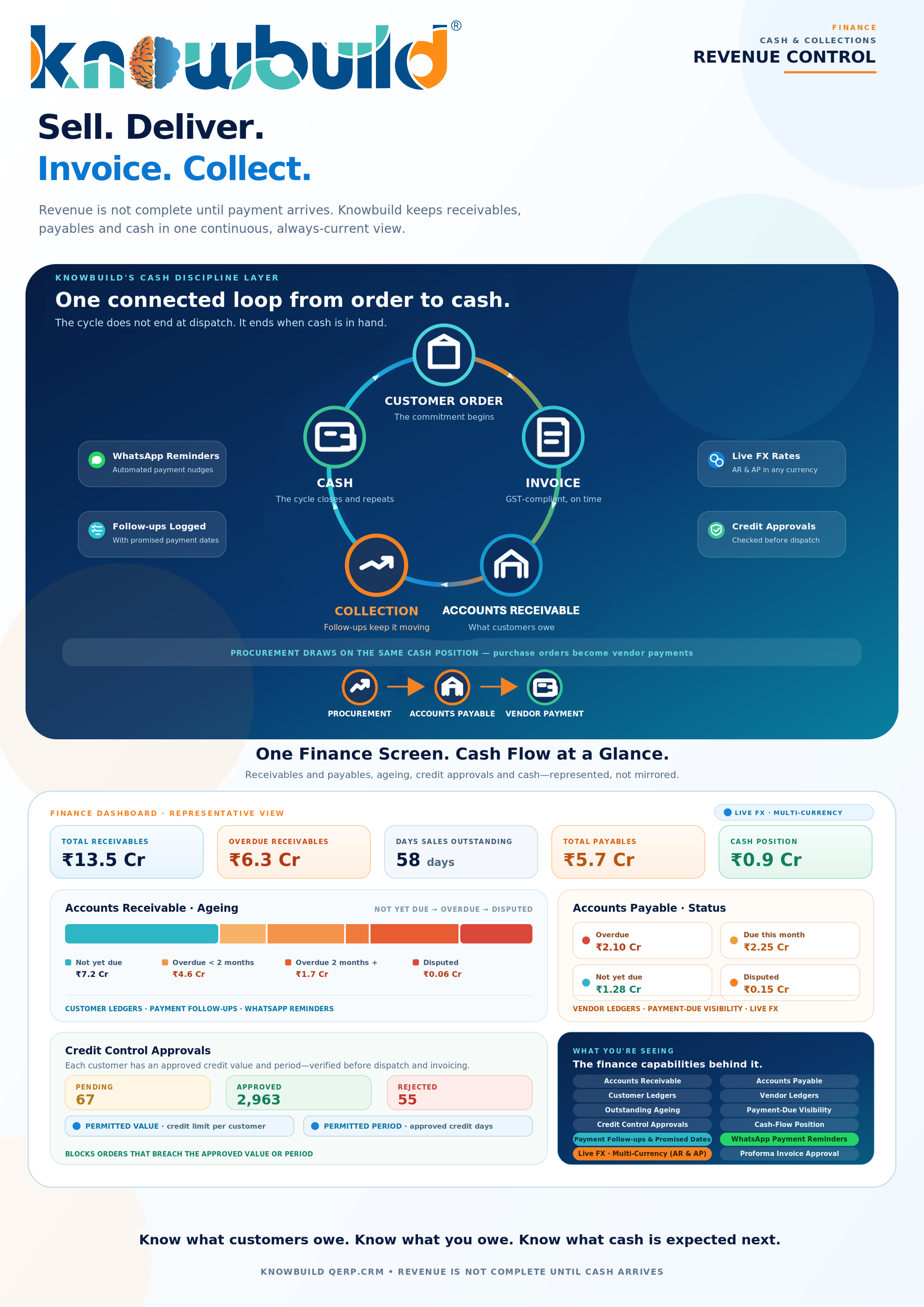
The cash loop begins where the order does. A customer order becomes a GST-compliant invoice issued on time, which becomes an accounts-receivable balance — what the customer owes — which is worked down by disciplined collection until cash closes the cycle and it repeats. Each stage feeds the next, and a break anywhere shows up as cash that never arrives.
Crucially, procurement draws on the same cash position, because purchase orders become vendor payments. When sales, purchasing, and finance all read from one cash position, the business can see the whole picture: cash coming in from customers, cash going out to vendors, and the gap between them that determines whether you can fund the next order.
This is the difference between managing cash and hoping about it. In a connected loop, you can trace a single rupee from the order that promised it, through the invoice that claimed it, to the collection that delivered it — and you can see, at any moment, how much is still in flight.
Control credit before it becomes bad debt
The cheapest bad debt is the one you never take on. Each customer should carry an approved credit value and an approved period, checked before dispatch and invoicing, so that an order which breaches the approved limit or terms is blocked rather than quietly shipped. Credit control moves from a monthly argument between sales and finance to a rule the system enforces at the moment of decision.
This protects the business at exactly the right point — before the goods leave — without punishing good customers. Orders within approved terms flow through untouched; only the risky ones stop for a decision. The result is fewer overdue receivables and far fewer genuinely bad debts, because the exposure was managed before it was created.
Approved credit is also a sales tool when it is visible. A salesperson who can see a customer’s available credit and payment history before promising terms can structure a deal that is both winnable and safe, rather than promising terms the business cannot afford to extend.
Make collection a system, not a scramble
Collection is where good intentions go to die. Everyone agrees payments should be chased; in practice, whoever has time this week chases whoever they remember. The result is inconsistent follow-up, uncomfortable calls, and receivables that age simply because no one got to them.
A connected system makes collection a process. Follow-ups are logged with promised payment dates, so a commitment made by a customer is recorded and tracked rather than forgotten. Automated WhatsApp reminders nudge customers about due and overdue invoices without your team making every call by hand — consistent, polite, and relentless in a way manual chasing rarely is.
This consistency is what pulls days-sales-outstanding down. Not a heroic collections drive once a quarter, but steady, systematic follow-up on every invoice, every week, with a clear record of who promised what and when.
Cash flow at a glance
With the loop connected, a single finance view shows total and overdue receivables, days sales outstanding, total payables, and the resulting cash position. Receivables ageing breaks into not-yet-due, overdue, and disputed; payables split the same way, so you can see not just what you are owed but how healthy that pipeline of incoming cash actually is.
For businesses that import or sell across currencies, live FX keeps multi-currency receivables and payables current, so the cash position reflects real exchange rates rather than a stale assumption. The number you are managing to is the number that is actually true today.
This at-a-glance view is what lets an owner or finance head make confident decisions: whether to take on a large order, whether to pay a vendor early for a discount, whether cash is tight enough to warrant action. Those decisions are only as good as the freshness of the numbers behind them.
What closing the loop changes
When order, invoice, receivable, and collection live in one loop, the whole rhythm of the business changes. Cash becomes predictable because you can see it coming. Bad debt shrinks because credit is controlled before dispatch. Collection improves because it is systematic. And the constant, low-grade anxiety of not quite knowing where the cash stands is replaced by a clear daily view.
The goal is plain and worth repeating: know what customers owe, know what you owe, and know what cash is expected next — every day, not at month-end. A business that can answer those three questions on demand is a business that can grow without lurching from one cash crunch to the next.
For a growing Indian SME, where a single large overdue receivable can jeopardise payroll or a supplier relationship, this is not a finance nicety. It is the difference between growth that is funded and growth that quietly runs the tank dry.
Cash discipline is what actually funds growth
There is a deeper reason to care about collection beyond avoiding bad debt: cash discipline is one of the cheapest sources of growth capital a business has. Every day you shorten your days-sales-outstanding, you free up cash that was trapped in receivables — cash you can use to buy stock, take on the next order, or simply stop borrowing. Improving collection is, in effect, raising working capital from inside the business rather than from a bank.
Consider what a growing order book does to cash. More sales mean more money tied up in receivables at any moment, so a business can be more profitable and more cash-strapped at the same time. If collection does not keep pace with growth, the very success of the business starves it of the cash it needs to keep growing — the classic trap that pulls down profitable SMEs. The order book looks healthy right up until a supplier or payroll cannot be paid.
This is why the order-to-cash loop deserves the same attention as sales itself. Pulling DSO down by even a week, on a growing receivables balance, can release a meaningful sum — and it compounds, because that freed cash funds the next cycle. A business that collects with discipline can grow faster on its own resources; one that does not has to fund every rupee of growth from outside, on someone else’s terms.
The tools that make this possible are unglamorous but decisive: credit controlled before dispatch so exposure never gets created, promised-date follow-ups so commitments are tracked, and automated reminders so chasing is consistent rather than sporadic. Together they turn collection from a monthly scramble into a steady engine that funds the business’s own expansion.
Where to start
Start by connecting the invoice to the order and the receivable, so that every sale has a traceable path to cash. Then put credit control before dispatch, so exposure is managed at the point it is created rather than discovered later.
Next, systematize collection: log promised dates and switch on automated reminders so follow-up happens consistently. Finally, bring receivables, payables, and cash into one view so you are always managing to today’s real position.
None of this asks your team to work harder at collections; it asks the business to work smarter by building the discipline into the system. The reminders go out whether or not someone remembered, the credit check happens whether or not sales thought to ask, and the cash position is current whether or not it is month-end. That is what turns cash from a source of recurring anxiety into a managed, predictable input to every decision the business makes.
The promise is a business where revenue reliably becomes cash — and where you can see, every single day, exactly where that cash stands.
Key takeaways
- An invoice is not cash; revenue completes only when payment arrives.
- Order, invoice, receivable, and collection belong in one connected loop that procurement also draws on.
- Approved credit limits checked before dispatch prevent bad debt at the source.
- Systematic follow-ups and automated reminders pull days-sales-outstanding down.
- One finance view shows receivables, payables, DSO, and cash position daily.
Put the insight into action
Build a business process your team can actually follow.
See how Knowbuild connects inquiries, follow-ups, quotations, orders, inventory, dispatch, finance, and execution in one Business Operating System.
Book a demo