The question everyone asks, and why it has no single answer
Search for ‘best CRM’ or ‘best ERP’ and you will find endless ranked lists, each confident and each different. The confidence is misleading. There is no single best CRM or best ERP, because ‘best’ is not a property of the software — it is a relationship between the software and a specific business at a specific stage.
A tool that is perfect for a fast-scaling company with a large sales team can be overkill for a ten-person distributor, and a tool that suits a simple operation can collapse under the complexity of a multi-warehouse importer. The same product earns five stars from one business and frustration from another, and both reviews are honest.
So the useful question is not ‘what is the best?’ but ‘what is right for us, now?’ That depends on two things: where your company is in its journey, and what your business actually requires to run well today — not what an idealised version of your business might need in five years.
First, understand the difference — and the overlap
A CRM (customer relationship management) system is built around the front of the business: leads, inquiries, follow-ups, quotations, and the relationship with the customer. An ERP (enterprise resource planning) system is built around the back of the business: inventory, procurement, dispatch, finance, and the resources that fulfil what the front office sells.
For years these were treated as separate purchases for separate departments, and for a service business with little inventory that separation can be fine. But for a B2B SME that sells physical goods, the front and back are not separate at all. An inquiry becomes a quote becomes an order becomes a dispatch becomes an invoice becomes a payment — one continuous chain that crosses the CRM/ERP line several times.
That is why, for many product businesses, the CRM-versus-ERP framing is the wrong one. The chain does not care which category a tool belongs to; it only cares whether the handoffs are connected. A great CRM and a great ERP that do not talk to each other can be worse than a single connected system that does both adequately, because the value lives in the seam between them.
Match the tool to your stage
Early on, when a founder and a couple of salespeople know every customer, the ‘system’ is often a spreadsheet and a shared inbox, and that is genuinely fine. The right tool at this stage is the simplest one that stops things being forgotten — usually a lightweight CRM to make sure inquiries and follow-ups do not slip.
As you grow into a real sales team and rising order volume, the constraint shifts. Now the pain is coordination: quotes with no version control, follow-ups that depend on who is free, and a fulfilment process held together by memory. This is the stage where a connected system starts to pay off, because the cost is no longer forgotten follow-ups but botched handovers between sales, stock, dispatch, and finance.
At the next stage — multiple warehouses, imports, credit exposure, a management team that needs real numbers — disconnected tools become an active drag. The reconciliation labour, the competing versions of the truth, and the inability to see the whole business at once cost more than any single tool saves. Here, an integrated business operating system stops being a luxury and becomes the thing that lets you keep growing.
Then, let your requirements decide
Stage tells you how much system you need; your specific requirements tell you which one. This is where generic ‘best of’ lists fail an Indian B2B SME most badly, because they rarely weigh the requirements that actually determine whether a tool will work for you.
Ask concrete questions. Does it handle GST e-invoicing and e-way bills natively, or will your team keep doing compliance in a parallel spreadsheet? Does it support multi-warehouse stock, multi-level BOM, and the import documents you deal with? Can it enforce credit control before dispatch? Does it fit how your team communicates — WhatsApp reminders, for instance — or fight it? Can it show management the whole inquiry-to-cash picture on one screen?
A tool that scores highly on a global feature checklist but forces you to work around it on the things you do every day is not the best tool for you, however many stars it has. The best tool is the one whose strengths line up with your real, daily requirements — and for a product business in India, those requirements are specific enough that they should drive the decision.
Beware the cost of the wrong fit
Choosing badly is expensive in ways that do not show up in the price list. Buy too much system too early and you pay for complexity you cannot use, in money and in the effort of running it. Buy too little, or too fragmented, and you pay in reconciliation labour, errors between systems, and decisions made on data that does not agree with itself.
The most common and costly mistake is assembling a stack of separate best-in-class tools and assuming integration will knit them into one. It rarely does, cleanly. The customer ends up existing in several databases, changes fail to propagate, and someone spends their week keeping the versions in sync. The ‘best’ CRM and the ‘best’ ERP can add up to a worse whole than one connected system.
There is also a switching cost to getting it wrong, because migrating data and retraining people is painful. It is worth choosing deliberately for the stage you are actually at and the near future you can see, rather than for a hypothetical scale you may never reach or an idealised setup that ignores your real requirements.
When one connected system is the right answer
For a growing B2B SME that sells physical goods — managing inquiries, quotes, stock, dispatch, credit, and cash — the CRM-versus-ERP debate usually resolves into a third answer: a single system that does both, connected end to end. Not because integrated is always better in the abstract, but because your inquiry-to-cash chain crosses the CRM/ERP boundary constantly, and every crossing is a place where separate tools leak.
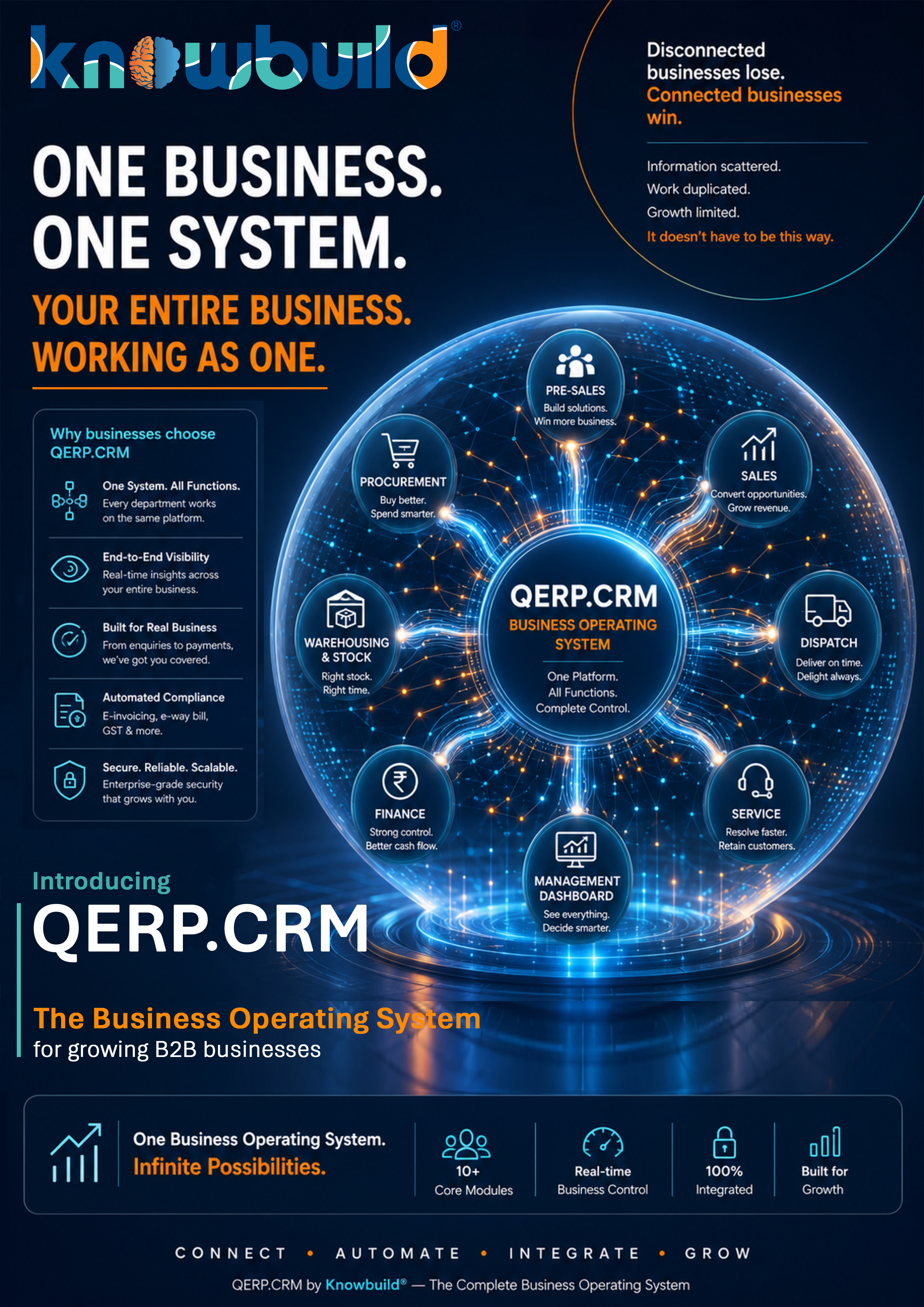
This is the idea behind a QERP.CRM — a business operating system that carries one record from inquiry through order, dispatch, invoice, and payment, with CRM and ERP as two views of the same connected flow rather than two products stitched together. The customer exists once. The order is entered once. Every team reads the same truth.
That does not make it the ‘best’ choice for everyone — a pure service business with no inventory may genuinely need only a CRM, and a very early startup may need only a spreadsheet. But for a product SME at the stage where handovers and cash visibility have become the constraint, a connected system is very often the right answer to a question that was never really about CRM or ERP at all.
How to actually decide
Skip the ranked lists and run your own short process. First, locate your stage honestly: are you fighting forgotten follow-ups, botched handovers, or an inability to see the whole business? The pain names the category of tool you need. Second, write down your non-negotiable requirements — GST compliance, multi-warehouse, credit control, the way your team communicates — and treat any tool that fails them as disqualified, however popular.
Third, weigh connection heavily. For a product business, ask not only how good each function is but how cleanly the functions join, because the seams are where value and errors both live. A slightly less shiny function inside one connected system often beats a brilliant one that has to be integrated and reconciled.
It also helps to be honest about the future you are actually buying for. Vendors sell to your aspirations — the scale you hope to reach — but you have to operate in the business you have. Choose for the stage you are at and the next twelve to twenty-four months you can genuinely see, with enough headroom to grow into, but not so much that you are paying today for complexity a much larger version of you might one day use. Deliberate beats aspirational when the switching cost of a wrong choice is this high.
Do that, and the anxious search for the single ‘best’ tool dissolves into a clear, answerable question: what does a business at our stage, with our requirements, actually need? Answer that, and you will have found the best CRM or ERP — the one that is best for you.
Key takeaways
- There is no universal best CRM or ERP — ‘best’ depends on your stage and requirements.
- For product businesses, the inquiry-to-cash chain crosses the CRM/ERP line, so connection matters more than category.
- Match how much system you need to your stage; let your specific requirements decide which one.
- Assembling separate best-in-class tools often creates reconciliation cost and competing versions of the truth.
- For a growing B2B SME, one connected system that does both is frequently the right answer.
Put the insight into action
Build a business process your team can actually follow.
See how Knowbuild connects inquiries, follow-ups, quotations, orders, inventory, dispatch, finance, and execution in one Business Operating System.
Book a demo