The strength that becomes the ceiling
Indian family businesses are built on formidable strengths: deep trust, long relationships, an owner who knows every customer and supplier personally, and the ability to make fast decisions without committees. In the first generation, this is a superpower. The founder holds the whole business in their head and steers it by instinct honed over decades, and it works remarkably well.
But the very thing that makes a family business strong early on becomes the thing that caps it later. When all the knowledge, all the relationships, and all the decisions live in one or two people, the business can only grow as far as those people’s personal bandwidth reaches. The founder becomes the bottleneck through which everything must pass.
This is the quiet ceiling that so many successful family businesses hit. Demand is there, the reputation is there, the opportunity is there — but the business cannot scale because it cannot function without the founder personally touching every important decision. Growing past that ceiling requires a different foundation, and that foundation is systemisation.
Why trust-and-memory stops scaling
In a small family business, coordination happens through conversation and memory. The father knows what stock is coming, the son remembers which customer is slow to pay, a trusted manager keeps the supplier relationships in his head. There is little written down because there is little need — everyone who matters is within earshot.
As the business grows, this model quietly breaks. There are too many orders, customers, and suppliers to hold in memory. New people join who were not there for the twenty years of context. Two family members remember a customer agreement differently. Information that used to flow through a shared dinner table now has to travel across a larger organisation — and without a system, it travels unreliably or not at all.
The symptoms are familiar: things slip because someone assumed someone else was handling them, decisions wait because only the founder has the full picture, and the next generation struggles to take responsibility because the knowledge they need is not written anywhere — it is in their father’s head. Trust and memory are wonderful, but they do not scale, and they do not transfer.
Systemisation is not the enemy of family values
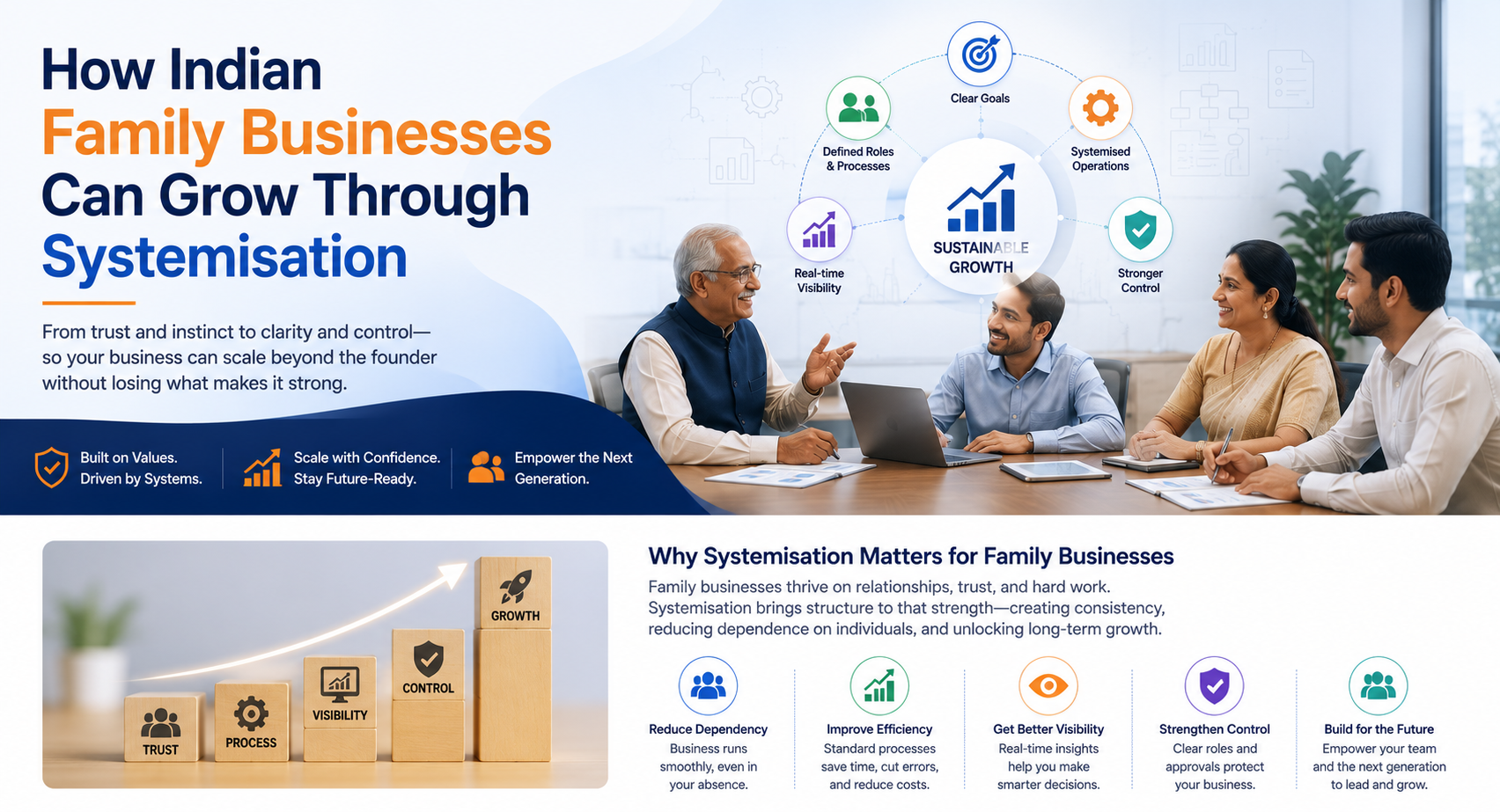
Many family-business owners resist systemisation because they fear it means becoming impersonal, bureaucratic, or corporate — losing the human, relationship-driven character that made them successful. This fear is understandable and, handled well, unfounded. Systemisation does not replace trust and relationships; it protects and extends them.
A system does not stop you knowing your customers personally. It makes sure that when you are not there, your team still knows each customer’s history, preferences, and terms — so the relationship survives beyond your personal presence. It does not remove the founder’s judgement; it captures the founder’s way of doing things so it can be applied consistently by others, at scale.
Think of systemisation as writing down the wisdom that currently lives only in the family’s heads, so that it becomes the business’s wisdom rather than the individuals’. The values, the standards, the way you treat customers and suppliers — these get encoded into how the business runs, so they endure as the business grows and as the next generation takes over.
What to systematise first
Systemisation should not start with abstract process charts. It should start with the core flow that every product business lives on: the journey from a customer’s inquiry to cash in the bank. Capture every inquiry so none depends on who happened to answer the phone. Standardise how quotes are made and orders confirmed. Connect the order to dispatch and to invoicing, and keep credit and collections disciplined.
Starting here matters because this flow is where a family business both makes its money and, unsystematised, loses it — in forgotten follow-ups, inconsistent pricing, botched handovers, and slow collection. Putting a system under the inquiry-to-cash flow delivers visible results quickly, which builds the family’s confidence to systematise further.
It also produces something a family business rarely has: real data about its own operation. Which customers and products actually drive profit, how long cash takes to come in, where orders stall. Decisions that were made on gut feel can now be checked against evidence — not replacing the founder’s instinct, but sharpening it.
From the owner in every decision to the owner in control
The most important shift systemisation enables is delegation without loss of control. In an unsystematised family business, delegation feels risky — hand a function to someone and you lose visibility into it, so the founder keeps pulling every decision back to themselves and stays the bottleneck. A system changes the trade-off.
When procurement, sales, dispatch, and finance all run on one connected system, the founder can genuinely delegate a function to a family member or a professional manager while still seeing exactly what is happening. The team lead makes the day-to-day decisions; the owner retains oversight through the shared, current picture rather than through personal involvement in every transaction.
This is how a family business grows past the founder’s personal bandwidth without losing the control the family rightly wants to keep. The same tight team can handle a much larger volume of business, because coordination and visibility are carried by the system instead of by the founder’s constant attention. The owner moves from being in every decision to being in control of the whole.
Preparing for the next generation
For family businesses, systemisation is also succession planning. The hardest part of passing a business to the next generation is not handing over the title; it is transferring the knowledge and judgement built over decades. When that knowledge lives only in the founder’s head, succession is fragile — a single retirement or illness can put the whole business at risk.
A systematised business is far easier and safer to hand over. Customer histories, supplier terms, pricing logic, and operating standards live in the system, so the next generation inherits a functioning machine rather than a pile of undocumented relationships they must reconstruct. They can step into a business that already runs on clear processes and real data, and add their own energy to it, rather than spending years simply learning what only their parent knew.
The next generation is also, typically, more comfortable running a business on systems and data than on informal memory. Giving them a systematised foundation plays to their strengths and lets them take the business further — which is, after all, the whole point of building something to pass on.
Keep the instinct, add the evidence
None of this means a family business should abandon the instinct and relationships that made it successful. The founder’s feel for the market, for a customer, for a deal is real and valuable, and no system replaces it. The goal is not to swap gut for spreadsheet; it is to give the gut better information to work with.
When a founder’s intuition is backed by data — on which customers pay well, which products truly earn, where cash is tied up — decisions get sharper, not more mechanical. The family keeps making the calls; they simply make them with evidence alongside experience, and they can explain and pass on the reasoning rather than keeping it locked in one person’s judgement.
This blend — the warmth and speed of a family business plus the discipline and visibility of a systematised one — is a genuinely powerful combination. It is how India’s best family businesses are making the leap from a successful first generation to an enduring, scalable enterprise.
Where to start
Start small and concrete. Pick the inquiry-to-cash flow — capture, quoting, orders, dispatch, and collection — and put a system under it, so the core of the business stops depending on memory. The quick, visible wins there will build the family’s confidence to go further.
Then use systemisation deliberately to delegate: give a family member or manager real ownership of a function, backed by the shared visibility that lets the founder stay in control without staying in every decision. Treat the data the system produces as a new input to the family’s judgement, not a replacement for it.
It is worth saying plainly that systemisation is a gift to the next generation, not a criticism of the last. The founder who built the business on relationships and instinct did exactly what the moment required, and did it brilliantly. Systemising is simply the next act of that same stewardship — making sure the enterprise the founder created can outlive any single person’s memory, and handing the children a platform to build on rather than a puzzle to reassemble.
The aim is not to make the business less of a family business. It is to build the infrastructure that lets a family business grow beyond what any one person can hold — rising above the ceiling that stalls so many, and becoming the enduring enterprise the family set out to create.
Key takeaways
- A family business’s strength — everything in a few trusted heads — becomes its ceiling as it grows.
- Trust and memory do not scale or transfer; systemisation turns family wisdom into business wisdom.
- Systemisation protects relationships and values rather than replacing them.
- Start with the inquiry-to-cash flow, then use the system to delegate without losing control.
- A systematised business is far easier to hand to the next generation — and plays to their strengths.
Put the insight into action
Build a business process your team can actually follow.
See how Knowbuild connects inquiries, follow-ups, quotations, orders, inventory, dispatch, finance, and execution in one Business Operating System.
Book a demo