Procurement is a timing problem
For a distribution or manufacturing SME, procurement is fundamentally about timing. Buy too late and confirmed orders stall, waiting for stock that should already have been on the shelf. Buy too early, or too much, and working capital sits frozen in inventory that will not convert to cash for months. Both mistakes are expensive, and both are common when purchasing runs on instinct.
The teams that get this right are not smarter buyers; they are better-informed ones. They buy against demand they can actually see — real reorder levels and real open sales orders — rather than against a gut feeling or last month’s pattern. The information, not the intuition, is what makes the difference.
The trigger for a purchase should therefore be automatic. The moment stock falls below its reorder level, or a sales order exceeds what is on hand, the system should flag the breach immediately — not wait for someone to notice it during a quarterly stock count, by which time an order may already be late.
From breach to recommended buy
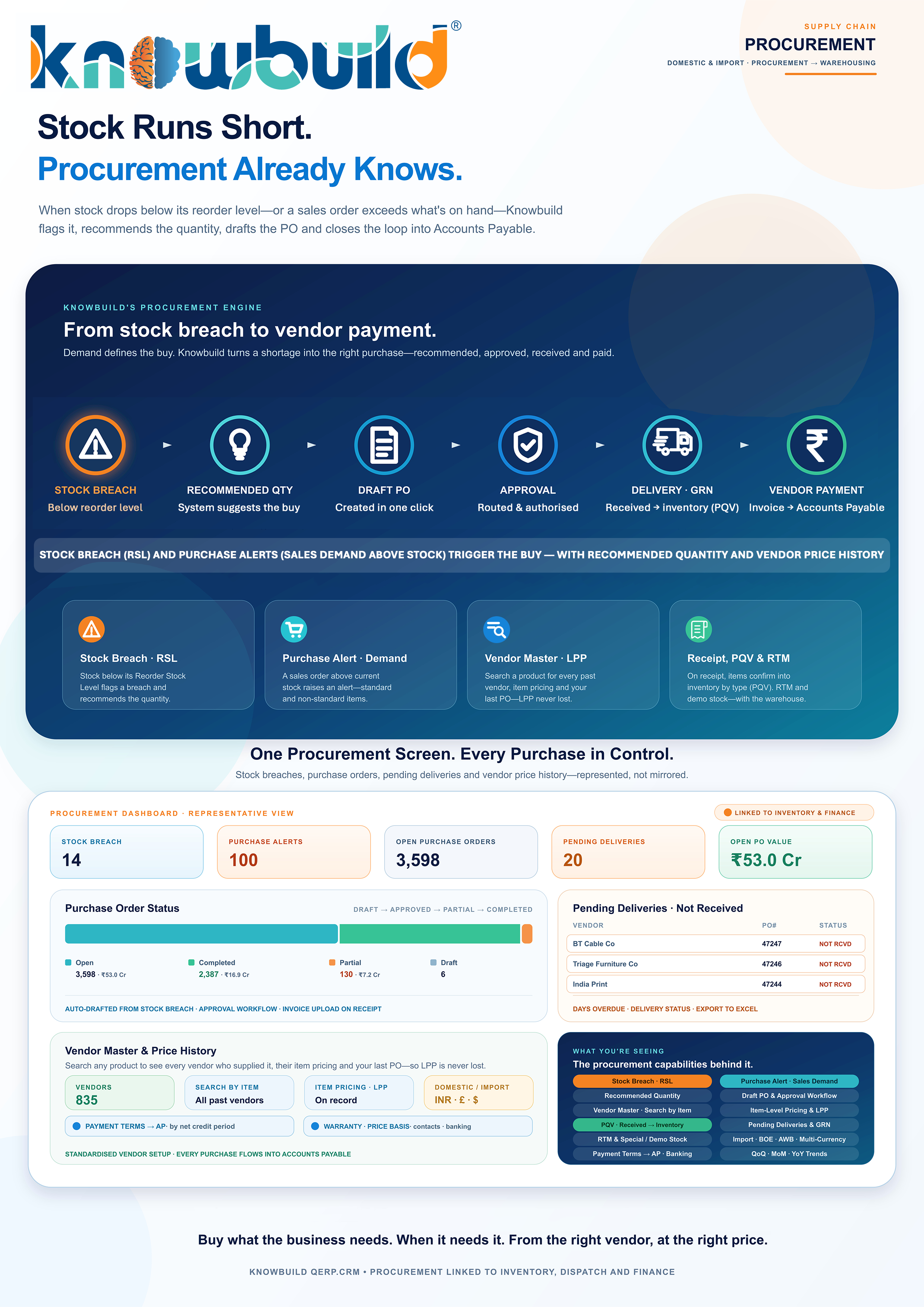
Once a breach is flagged, the next step should be a recommendation, not a blank purchase-order form. A demand-driven system suggests the quantity to buy based on the shortfall and demand, drafts the purchase order in one click, and routes it for approval. Nothing is retyped, and no shortage waits on someone remembering to act.
This matters because the manual version of this process is where errors and delays live. A person notices a shortage, tries to remember how much to order, checks a spreadsheet that may be out of date, and types up a PO. Each of those steps can go wrong or simply not happen. Automating the path from breach to draft PO removes the human bottleneck without removing human judgement — approval still sits with a person.
Because the buy is driven by reorder levels and open demand, procurement stops being reactive firefighting and becomes a steady rhythm. Shortages are anticipated rather than discovered, and the business spends less time expediting emergency orders at a premium.
Buy from the right vendor at the right price
Good purchasing is not only about buying at the right time; it is about buying from the right vendor at the right price. That requires memory. A vendor master that carries every past vendor, their item-level pricing, payment terms, and history lets you compare a primary quote vendor against a secondary quote vendor before you commit — so the last price you paid is never lost, and you never re-negotiate blind.
For SMEs that import, price discipline extends to currency. Multi-currency purchasing that carries landed cost in INR, GBP, or USD means you are comparing the true delivered cost of a part, not just the headline price. Import documents like BOE and AWB stay attached to the purchase, so the full cost and paper trail of an imported item live in one place.
Over time, this vendor intelligence compounds. Quarter-on-quarter and year-on-year purchase trends show where spend is concentrated, which vendors are reliable, and where pending deliveries are piling up — turning procurement from a series of one-off buys into a managed supplier strategy.
Approvals that add control without adding friction
As a business grows, uncontrolled purchasing becomes a real risk — not usually through fraud, but through well-meaning people buying more than the business needs or from the wrong vendor. The answer is not to make every purchase slow; it is to route approvals intelligently so that control lands where it matters.
A draft PO generated from a genuine stock breach, within normal parameters, can move quickly. A purchase that is unusually large, from a new vendor, or outside normal terms can require a higher approval. Encoding these rules means the routine flows fast and the exceptional gets scrutiny, rather than everything crawling through the same bottleneck.
This is how procurement stays both fast and controlled as volume grows. The people approving see what they need to see — the recommended quantity, the vendor comparison, the price history — and can decide with confidence rather than rubber-stamping or blocking.
Close the loop into accounts payable
A purchase is not finished when the goods arrive. Delivery and GRN are logged against the order, the invoice is captured on receipt, and every purchase flows into accounts payable and the cash position. Procurement, inventory, and finance read from the same numbers, so the business always knows what it has bought, what is still coming, and what it owes.
This closing of the loop is what separates a procurement function from a pile of purchase orders. When the buy connects to payables and cash, you can see the full picture: open POs and their value, pending deliveries not yet received, and the effect of all of it on your cash position. Purchasing decisions and cash-flow decisions stop being made in separate rooms.
For an SME where working capital is the constraint on growth, this connection is decisive. Every rupee committed to a purchase is visible against the cash it will consume, so you can buy what the business needs without accidentally starving it of the cash it needs to operate.
What demand-driven procurement changes
The outcome is easy to state and hard to achieve without one connected system: buy what the business needs, when it needs it, from the right vendor, at the right price. Stock-outs that stalled orders become rare because shortages are anticipated. Dead inventory shrinks because you stop over-buying ‘just in case’. Emergency purchases at premium prices fade because the rhythm is steady.
Management gains a procurement view that was previously scattered: how many stock breaches are open, how many purchase alerts are live, the value of open purchase orders, and how many deliveries are pending. Instead of discovering a supply problem when a customer’s order cannot ship, the business sees it forming and acts.
And because procurement is linked to inventory, dispatch, and finance, a purchasing decision is never made in isolation. It reflects real demand upstream and real cash constraints downstream — which is exactly what ‘demand-driven’ means in practice.
The import dimension Indian SMEs cannot ignore
For the many Indian SMEs that import, procurement carries a layer of complexity that domestic-only buyers never face, and it is precisely this layer that generic tools handle worst. Imported goods have long and variable lead times, so the ‘buy on time’ window opens much earlier — a stock breach that would trigger a quick domestic PO might, for an imported part, already be too late. Planning has to reach further ahead.
Cost is also harder to see. The price on a foreign vendor’s quote is not the cost of the part; duty, freight, and currency movement all sit between the quote and the true landed cost. Buying well means comparing landed costs in INR, GBP, or USD, not headline prices — and keeping the import documents, BOE and AWB, attached to the purchase so the full cost and paper trail live in one place for finance and for audit.
A procurement function that treats imports as a first-class case — longer planning horizons, multi-currency landed cost, and import documentation as part of the record — gives an importing SME control that spreadsheets simply cannot. It is the difference between knowing what an imported part truly costs and truly costs to hold, and discovering it after the fact when the duty and freight invoices arrive.
Where to start
Start with the trigger: set reorder levels and let the system flag a breach the moment stock falls short or demand exceeds supply. That single change moves you from discovering shortages to anticipating them.
Then build out the vendor master so that price history and terms are captured and comparable, add approval routing so control lands where it matters, and connect receipts into accounts payable so every purchase closes into the cash position.
The reward for getting procurement right compounds quietly over time. Every avoided stock-out is an order that shipped on schedule; every avoided over-buy is cash that stayed available for something more useful; every well-compared purchase is margin protected. Individually these are small wins, but across hundreds of purchases a year they add up to a materially healthier, more resilient business — one that can say yes to growth because its supply and its cash are both under control.
The promise is a procurement function that runs on demand rather than guesswork — protecting both your service levels and your working capital as you grow.
Key takeaways
- Procurement is a timing problem — buying late stalls orders, buying early freezes cash.
- A stock breach should automatically flag, recommend a quantity, and draft the PO.
- A vendor master with price history and multi-currency landed cost enables real comparison before you buy.
- Smart approval routing keeps routine buys fast and scrutinizes the exceptional ones.
- Every purchase closes into accounts payable and the live cash position.
Put the insight into action
Build a business process your team can actually follow.
See how Knowbuild connects inquiries, follow-ups, quotations, orders, inventory, dispatch, finance, and execution in one Business Operating System.
Book a demo