The handover is where orders break
In most growing businesses the order itself is not the problem — the handovers are. Sales confirms a deal, then someone re-enters it for the warehouse, someone else for dispatch, someone else again for invoicing. Each re-keying is a fresh opportunity for a wrong item, a missed delivery date, or a document that no one can find three months later.
Every handover also adds delay. The order waits in one person’s queue to be copied into the next system, then waits again. What looks like a fulfilment problem — slow dispatch, wrong shipments — is often really a coordination problem created by passing the same order between disconnected tools.
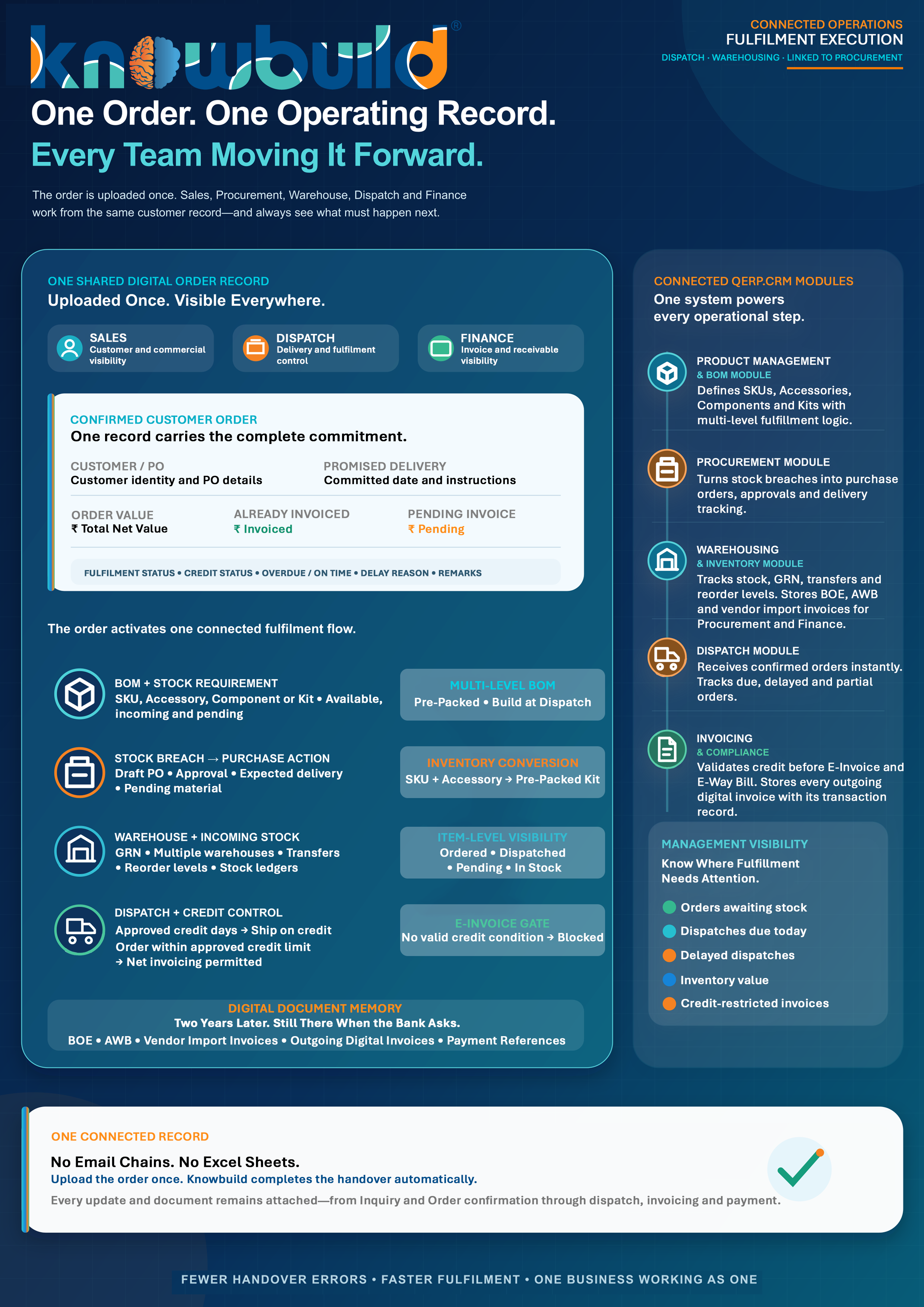
The fix is structural, not heroic. Instead of a chain of copies, the order becomes one shared digital record: uploaded once, visible everywhere. Sales sees the customer and commercial view, dispatch sees fulfilment, finance sees invoicing and receivables — all reading from the same record rather than their own copy of it.
One record carries the complete commitment
A confirmed customer order should carry everything the business has promised in one place: customer and PO details, the committed delivery date and any special instructions, the order value, what has already been invoiced, and what is still pending. Fulfilment status, credit status, delay reasons, and remarks live on the same record rather than scattered across messages and calls.
When one record holds the whole commitment, every team is always looking at the same truth. There is no version in sales that disagrees with the version in dispatch. There is no ‘let me check with accounts’ because accounts are reading the same record. Everyone can always see what has happened and, just as importantly, what must happen next.
This single-record discipline is what makes an order auditable in real time. At any moment you can answer the questions that matter — is this order on time, is it within credit, what is left to invoice — without assembling the answer from four systems and two inboxes.
The order activates one connected flow
From that single record, fulfilment runs as one flow rather than a series of disconnected tasks. The bill of materials and stock requirement is checked — available, incoming, and pending — across multiple warehouses, including multi-level BOM for items that are pre-packed or built at dispatch. A stock breach does not sit and wait to be noticed; it automatically becomes a purchase action with a draft PO, an approval step, and an expected delivery date.
Warehouse movement stays visible at item level: ordered, dispatched, pending, in stock, with GRN, transfers, and reorder levels all tied to the same order. Dispatch is gated by credit control, so an order only ships on credit when the customer is within approved terms and limits; an order that breaches them is held rather than quietly shipped into a bad debt.
At the point of dispatch, a compliant e-invoice and e-way bill are generated directly, and scan-to-pack validation checks that the item leaving the warehouse is the item on the order. The handover from sales to warehouse to finance stops being a set of disconnected spreadsheets and becomes an accountable sequence where each step confirms the last.
Credit control belongs inside fulfilment, not beside it
One of the most common and costly mistakes in SME operations is treating credit as a finance concern that gets checked — if at all — after dispatch. By then the goods are gone. If the customer was over their limit or outside approved terms, the business has just financed a risk it never agreed to take.
In a connected system, the credit check happens where the decision actually is: at dispatch. The approved credit value and period for each customer are verified before the order ships. Within the approved limit, net invoicing proceeds automatically; outside it, the order is blocked until someone with authority decides. Credit control moves from a monthly argument to a rule the system enforces at exactly the right moment.
This protects cash without slowing down good customers. Orders that are within terms flow through untouched. Only the genuinely risky ones stop for a human decision — which is precisely where a human decision adds value.
Documents that are still there two years later
Fulfilment does not end when the truck leaves the gate. In a B2B business, especially one that imports, the paperwork around an order has a long life. A bank, an auditor, or a customer dispute can ask about a shipment years later, and the answer has to be findable.
When every document attached to the order — BOE, AWB, vendor import invoices, outgoing digital invoices, payment references — stays with the record, that answer is one click away rather than a search through inboxes and drawers. The order becomes a permanent, complete account of what was promised, what was shipped, what was invoiced, and what was paid.
This digital document memory is quietly one of the biggest advantages of a connected system. It turns compliance from a scramble into a lookup, and it means the knowledge of an order does not walk out the door when an employee does.
What connected fulfilment changes for the business
The headline outcomes are fewer handover errors and faster fulfilment, but the deeper change is in how the business feels to run. Wrong shipments — one of the most damaging and avoidable errors in B2B — drop toward zero when dispatch is linked to the actual order and validated at pack. Delivery dates become reliable because everyone works from the same committed date.
Management gains a view it never had: orders awaiting stock, dispatches due today, delayed dispatches, and the value tied up in each. Instead of chasing status by phone, a manager can see where fulfilment needs attention and act before a customer complains.
For a growing SME, this is the difference between operations that scale and operations that break. Adding more orders no longer means adding proportionally more coordination overhead, because the coordination is done by one shared record rather than by people re-keying and reconciling.
Partial orders, back-orders, and the messy real world
Fulfilment in a real B2B business is rarely clean. A customer orders ten line items and only eight are in stock; do you hold the whole order or ship what you have? A large order is dispatched in two lots across a week. A part is on back-order from a vendor while the rest is ready to go. These situations are the norm, not the exception, and they are exactly where disconnected systems lose track of what has actually happened.
A connected order record handles this by tracking status at the item level, not just the order level: ordered, dispatched, pending, in stock. A partial dispatch reduces the pending quantity without closing the order, so the remainder is never forgotten and the customer is never left wondering when the rest arrives. The back-ordered part links to the purchase action that will fulfil it, so the loop closes when stock comes in.
This granularity matters because the alternative — treating every order as all-or-nothing — forces staff into workarounds: side spreadsheets of ‘what is still pending’, manual notes, and follow-up calls that depend on memory. Those workarounds are where partial orders quietly fall through. When the system itself understands partials and back-orders, the messy real world is handled inside the process rather than patched around it.
Where to start
Begin by making the confirmed order a single record that every team reads from, rather than a document that gets copied into each department’s own system. That one change removes the largest source of handover error.
Then connect the steps that most often break: link dispatch to the actual order with scan-to-pack validation, put the credit check at dispatch, and generate the e-invoice and e-way bill from the same flow. Finally, attach every document to the order so the record is complete and permanent.
It is worth remembering that customers experience your fulfilment, not your org chart. They do not see the handovers between sales, warehouse, dispatch, and finance; they only see whether the right goods arrived on the promised date with a correct, compliant invoice. Connecting the flow internally is really about making that external experience reliable — and reliability, order after order, is what turns a one-time buyer into a repeat customer who trusts you with bigger orders.
The promise is simple: upload the order once, and the handover completes automatically — with fewer errors, faster fulfilment, and one business genuinely working as one.
Key takeaways
- Orders break at the handovers, not in the selling — every re-keying risks an error and a delay.
- One shared order record lets sales, warehouse, dispatch, and finance work from the same truth.
- Credit control belongs at dispatch, enforced by the system, not checked after goods have shipped.
- GST-compliant e-invoicing and e-way bills generate inside the same fulfilment flow.
- Every document stays attached to the order, findable for audits years later.
Put the insight into action
Build a business process your team can actually follow.
See how Knowbuild connects inquiries, follow-ups, quotations, orders, inventory, dispatch, finance, and execution in one Business Operating System.
Book a demo