Growth is what breaks the spreadsheet
Most SMEs are run, in the early years, on a heroic combination of spreadsheets, WhatsApp, email, and a few good people who remember everything. It works — until it doesn’t. As volume grows, the same informal system that got you here starts dropping inquiries, mis-shipping orders, and losing track of who owes what. Growth, paradoxically, creates chaos before it creates scale.
The chaos is not a sign of failure; it is a sign of success outrunning its systems. More customers, more orders, more vendors, and more staff mean more connections between things — and informal systems hold connections in people’s heads. When there are too many to hold, things start slipping through the gaps between them.
The instinct at this point is to buy more tools: a CRM here, an accounting package there, an inventory app beside it. But bolting tools together recreates the original problem in a more expensive form — disconnected islands of data that each tell a slightly different version of the truth, with people manually copying between them to keep the versions in sync.
Why more tools make the problem worse
It is worth being precise about why a stack of separate best-in-class tools disappoints so many growing businesses. Each tool is excellent at its own job, but the value of a business operating system is not in any single function — it is in the connections between functions. And connections are exactly what a collection of separate tools cannot provide.
So the same order gets entered into the CRM, then the inventory system, then the accounting package. The customer exists three times, slightly differently, in three databases. A change in one does not propagate to the others. Someone spends their week reconciling, and the ‘single source of truth’ each vendor promised turns out to be one of several competing sources.
The cost is not just the reconciliation labour. It is the decisions made on data that is subtly wrong, the errors that slip between systems, and the fact that no one can see the whole business at once because the whole business lives in pieces. More tools, more integrations to maintain, more places for the truth to diverge.
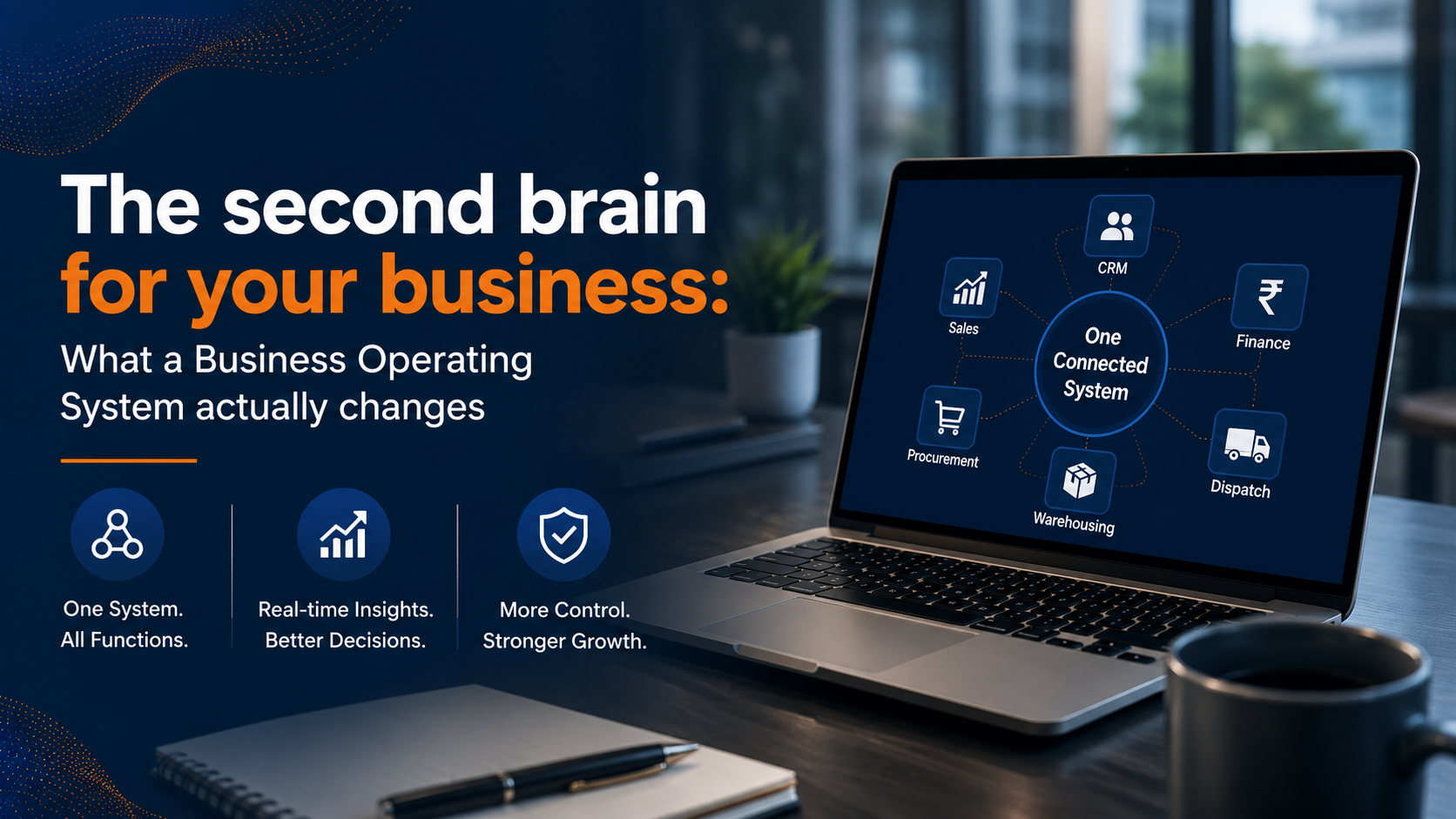
Not another tool — a system that runs the business
A business operating system is a different idea from a stack of apps. Instead of modules bolted together, one record runs from inquiry to cash, and every team — pre-sales, sales, orders, warehouse, procurement, dispatch, invoicing, finance — sees the same truth. The same inquiry becomes an order, a dispatch, an invoice, and a receipt without anyone re-keying it into a different system.
That single connected flow is what lets a management dashboard show the whole business on one screen: inquiries today, inquiry-to-order conversion, open orders, dispatches due, open purchase orders, receivables, days sales outstanding, and cash position — each number drawn from one flow rather than reconciled from four systems. When one record is every team’s record, the dashboard is not a report someone compiled; it is the live state of the business.
This is why the metaphor of a second brain fits. The system remembers every customer, every order, and every commitment, and it connects them, so the business does not depend on any one person holding it all in their head. It plans the next step, keeps every rupee accounted for, and works in the background while people do the work only people can do.
Built for how Indian SMEs actually operate
A system is only as useful as its fit with the real business, and for Indian B2B SMEs that fit is specific. It means GST e-invoicing and e-way bills generated inside the flow, not bolted on afterwards. It means WhatsApp reminders for payments, because that is how Indian businesses actually communicate. It means import documents like BOE and AWB, multi-currency landed cost, and the tax and compliance logic of doing business in India built into the core.
When these are native to the system, the daily operating stack — sales, finance, procurement, stock, dispatch, and support — holds together instead of fragmenting across vendors who each handle one piece and none handle the seams. The compliance and communication your team already does every day happens inside the system rather than in spite of it.
This local fit matters more than it first appears. A generic global tool can force an Indian SME to work around it — keeping the ‘real’ compliance and communication in parallel spreadsheets and chat. A system built for the context lets the business run one way, not two.
Proven in a real business, not a lab
The strongest argument for a connected system is a business that grew on one. Knowbuild did not begin as software. It began inside a real distribution company — multi-SKU, both import and domestic, with working capital locked up in stock and the everyday chaos of a growing B2B operation. The system was built to run that business, and it grew that business several times over across a handful of years before it was ever sold as a product.
That origin shows up in the details. The workflows match how orders, stock, and cash actually move in an SME, because they were shaped by moving them. The compliance is there because the business needed it. The credit control exists because slow payment was a real threat, not a hypothetical feature.
For an owner evaluating whether to move off a pile of disconnected tools, this is the relevant question: was this built by people who ran a business like mine, or assembled by people who studied one? A system proven in a real operation carries the scars and the lessons that a lab-built one does not.
What actually changes when the business runs as one
The concrete change is that one record, entered once, serves every team. No re-keying, no reconciliation, no competing versions of the customer or the order. The same inquiry becomes an order, a dispatch, an invoice, and a receipt in one continuous flow, and every number a manager looks at comes from that flow rather than from a report someone assembled by hand.
The felt change is calmer growth. Adding orders stops adding proportional coordination overhead, because the coordination is done by the shared record. People spend less time chasing status and copying data, and more time on the judgement and relationships that actually move the business. The month-end surprise — discovering where things really stood only after the fact — gives way to a daily, accurate picture.
And the strategic change is visibility. When the whole business is on one screen, an owner can lead it deliberately rather than reactively: seeing conversion, fulfilment, and cash together, spotting problems as they form, and making decisions on data that is actually true. That is what it means for growth to finally turn into scale.
Where to start
You do not have to replace everything on day one. The most useful starting move is to pick the seam that hurts most — usually the handoff from sales to fulfilment, or from dispatch to finance — and connect it so one record carries across it. The relief of eliminating one re-keying step is usually enough to make the case for the next.
Resist the temptation to wait for the ‘perfect’ moment or the complete rollout. There is rarely a quiet quarter in a growing business, and the cost of the disconnected setup keeps accruing while you wait. Connecting even one seam starts returning value immediately — a re-keying step removed, an error class eliminated — and that early, visible win is what earns the organisation’s appetite for the next connection.
From there, the pattern repeats: each connection you add removes a reconciliation, closes a gap where errors and delays lived, and adds to the single view of the business. The end state is not more software to manage but less — one connected system in place of a stack of disconnected ones.
It also helps to set expectations honestly with your team. Moving to a connected system changes habits, and habits resist change even when the new way is easier. The businesses that adopt well treat it as an operational shift, not just a software install: they pick one workflow, prove the benefit, and let the people who feel the relief become the advocates for the next step. Momentum built this way is far more durable than a big-bang rollout imposed from the top.
The shift worth aiming for is simple to describe and hard to overstate: not another tool to maintain, but one connected system that remembers every customer, plans every next step, and keeps every rupee accounted for — from the first inquiry all the way to cash in hand.
Key takeaways
- Growth breaks informal systems — more disconnected tools make it worse, not better.
- The value of a business operating system is in the connections between functions, not any single feature.
- One record runs from inquiry to cash, so every team sees the same truth and the dashboard is live.
- Built-in GST, e-way bills, WhatsApp, and multi-currency fit how Indian SMEs actually work.
- A system proven in a real business carries lessons a lab-built one cannot.
Put the insight into action
Build a business process your team can actually follow.
See how Knowbuild connects inquiries, follow-ups, quotations, orders, inventory, dispatch, finance, and execution in one Business Operating System.
Book a demo